
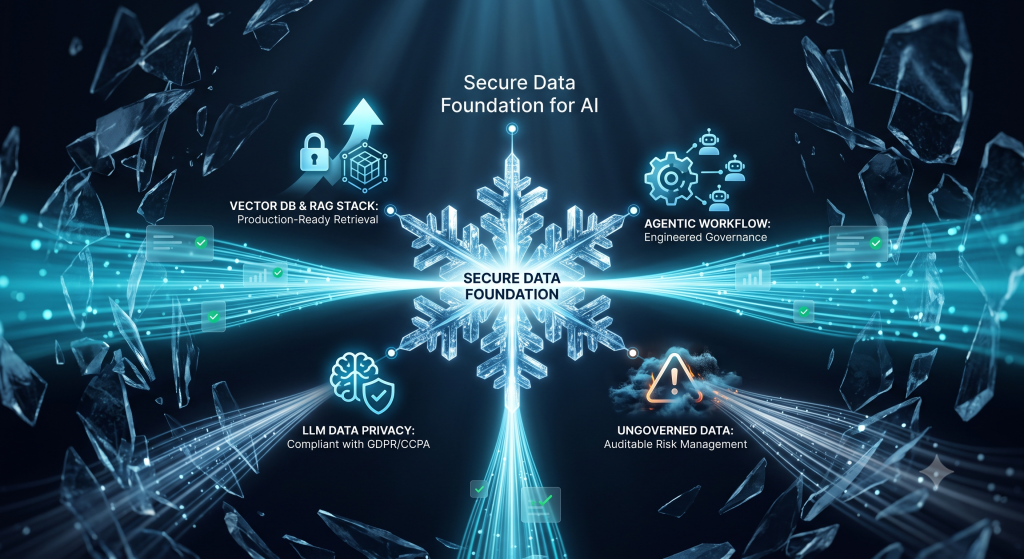
The transition of artificial intelligence from experimental sandboxes to enterprise production environments has exposed a critical operational reality: an organization’s AI capabilities are only as resilient, accurate, and safe as the infrastructure supporting them. Establishing a secure data foundation for AI is no longer a theoretical exercise but a fundamental prerequisite for deploying intelligent systems that drive measurable business value. Without this robust infrastructure, enterprises face the compounded threats of hallucinated outputs, severe data privacy breaches, and unmitigated algorithmic liability. As the market consolidates around multi-modal architectures and autonomous systems, data governance must evolve from a compliance checkbox into the core engine of technical strategy.
💾 Infrastructure Selection: Vector Database Implementation for SMEs
The core of any modern retrieval system is the vector database, which allows applications to locate information based on semantic relevance rather than rigid keyword matching. However, executing a vector database implementation for SMEs requires carefully balancing performance demands against operational overhead. Two years ago, vector storage was a niche consideration; today, it is a primary architectural decision that dictates latency, scalability, and operational costs.
The market has largely consolidated around three distinct paradigms: native relational extensions, specialized open-source engines, and fully managed serverless deployments. For many enterprises already operating within a PostgreSQL ecosystem, pgvector serves as the default choice. By implementing Hierarchical Navigable Small World (HNSW) indexes directly in C, pgvector allows vector embeddings to reside alongside relational data, enabling developers to perform similarity searches and SQL joins in a single transactional query. While this simplifies backups and role-based access control, its performance degrades at massive scale; index rebuild times on datasets exceeding 50 million chunks can take upwards of six hours.
Conversely, Qdrant is engineered in Rust specifically for high-throughput vector search. It executes complex metadata filtering within the graph traversal itself, resulting in significantly lower latency for highly selective queries. For organizations prioritizing developer velocity over infrastructure control, Pinecone offers a fully managed, serverless architecture that eliminates index tuning and replica management, albeit at a steeply compounding cost at scale.
| Database System | Architectural Paradigm | p50 Query Latency (Approx.) | Index Build Time (5M Vectors) | Optimal Enterprise Deployment |
| pgvector (w/ pgvectorscale) | PostgreSQL Extension (C/Rust) | 28ms – 31ms | ~45 minutes | Workloads under 50M chunks requiring ACID compliance and strict data sovereignty. |
| Qdrant | Specialized Engine (Rust) | 8ms – 30ms | ~12 minutes | High-throughput environments requiring complex payload filtering and horizontal scaling. |
| Pinecone | Fully Managed SaaS | 25ms | N/A (Managed) | Rapid prototyping and zero-ops environments where infrastructure costs are secondary to developer speed. |
🏗️ Beyond Naive Retrieval: Building a Production Ready RAG Stack
Deploying a powerful LLM is insufficient if it lacks access to proprietary, up-to-date organizational knowledge. Building a production ready RAG stack (Retrieval-Augmented Generation) bridges this gap by grounding the model’s generation in retrieved facts, effectively reducing hallucinations by up to 96% when properly tuned. However, the naive approach of simply mapping document chunks to a vector store and feeding them directly to an LLM routinely fails in production, introducing 800ms to 2 seconds of latency per query and returning mismatched contexts.
A true enterprise RAG architecture relies on a multi-stage pipeline. The first vital evolution is hybrid search. Relying strictly on dense semantic embeddings often misses exact-match keyword queries, such as specific part numbers or regulatory acronyms. Modern systems run sparse retrieval (like BM25) concurrently with dense vector search, fusing the results to capture both semantic intent and precise terminology.
Once candidate chunks are retrieved, the pipeline must employ cross-encoder reranking. Instead of relying purely on vector cosine distance, a dedicated reranker evaluates the actual relevance of the top retrieved chunks against the original user query, reordering them before they enter the LLM’s context window. Finally, continuous evaluation frameworks utilizing an “LLM-as-a-judge” methodology are critical. By measuring retrieval recall, context relevance, and answer faithfulness against human-validated ground truth, engineering teams can detect index drift and performance degradation before they impact end-users.
⚙️ Scaling Autonomy: Agentic Workflow Engineering
While RAG excels at answering questions based on static knowledge, it is fundamentally a passive retrieval mechanism. For tasks that require reasoning, tool utilization, and sequential decision-making, organizations must adopt agentic workflow engineering. This discipline transforms a monolithic LLM prompt into a modular, multi-step orchestration where agents decompose high-level objectives into executable sub-tasks.
The primary challenge in agentic systems is context management. Flooding an agent with unstructured databases or hundreds of pages of uncurated documentation leads to token bloat, increased latency, and severe hallucinations. Effective workflow engineering strictly scopes the context packet for each step. For example, an autonomous invoice auditing agent does not ingest an entire vendor history at once; it uses a predefined heuristic to filter suspicious anomalies, clusters the data, calls an LLM strictly to analyze duplicate charges, and then generates an explainable recommendation.
Furthermore, production agents must be bound by durable execution parameters. Without proper state persistence and structured interception hooks (such as PreToolUse blockers), long-running agents can suffer from progressive context loss, abandoning partial work or executing destructive actions if they enter an uncontrolled loop.
⚠️ Threat Mitigation: Security Risks of Ungoverned Data in AI Agents
Granting autonomous agents read and write access to enterprise systems introduces an entirely new attack surface. The security risks of ungoverned data in AI agents have escalated sharply, particularly through Indirect Prompt Injection (IPI) attacks. Unlike a direct jailbreak where an attacker types malicious commands into a chat interface, an IPI attack occurs when an agent ingests poisoned data from an external source—such as a compromised website, an email attachment, or a parsed PDF.
When an LLM processes this poisoned content, it interprets the hidden attacker commands as legitimate instructions, seamlessly overriding its initial safety guardrails. Attackers utilize sophisticated concealment methods to hide these instructions from human reviewers while ensuring they are parsed by the agent’s web-crawling capabilities.
| Concealment Technique | Mechanism of Action | Observed Attack Impact |
| CSS Rendering Suppression | Text is hidden using font-size: 0px, display: none, or transparent coloring. | Manipulates AI screening tools, alters summarization pipelines, and executes data destruction. |
| Structured Metadata Spoofing | Malicious prompts are embedded in JSON-LD or HTML <meta> tags. | Performs typosquatting (e.g., impersonating the DeBank platform) to execute unauthorized cryptocurrency transactions. |
| Trigger-Activated Rules | “Sleeping” instructions are ingested but remain dormant until a specific keyword is processed. | Induces covert API key exfiltration and conditional traffic hijacking. |
| Internal Token Impersonation | Content is wrapped in pseudo-system tags or fake safety override hashes. | Causes denial-of-service by triggering artificial safety refusals or overriding system-level instructions. |
Preventing these catastrophic breaches requires defense-in-depth strategies. Organizations must sanitize all HTML and rich-text formatting in browsing pipelines, aggressively strip invisible layers from PDFs, and enforce the principle of least privilege, ensuring an agent cannot execute outbound emails or financial transactions without a human-in-the-loop cryptographic approval.
⚖️ Navigating the Complexities of Data Privacy and Compliance
A sophisticated AI architecture is legally untenable if it violates emerging data privacy and compliance mandates. Governments globally are replacing voluntary ethical guidelines with stringent, penalty-backed legislation.
In Canada, the Artificial Intelligence and Data Act (AIDA), bundled within Bill C-27, is poised to strictly regulate “high-impact” AI systems in the private sector. The legislation demands proactive risk assessment, anonymization of data pipelines, and continuous human oversight, backing these requirements with administrative monetary penalties that can scale to the greater of $10,000,000 or 3% of a corporation’s global gross revenue. Similarly, the EU AI Act enforces outright prohibitions on unacceptable risk applications while mandating rigorous data provenance for general-purpose models.
Regulatory scrutiny is particularly focused on automated employment decision-making. In Ontario, the Working for Workers Four Act (Bill 149) introduces a legal mandate effective January 1, 2026, requiring employers to explicitly disclose the use of AI to screen, assess, or select applicants in publicly advertised job postings. Compliance requires profound transparency; employers must retain job postings and application records for three years, and critically, they cannot outsource liability. If a third-party AI hiring tool exhibits algorithmic bias—often inherited from historically skewed training data—the employer utilizing the tool remains entirely legally responsible for the resulting human rights violations.
To survive this regulatory landscape, IT leadership and legal departments must collaborate to enforce algorithmic transparency, ensure strict data minimization, and audit models continuously for discriminatory drift.
🚀 Synthesizing the Future of Enterprise AI
The trajectory of enterprise artificial intelligence demands a radical shift from experimental tinkering to disciplined systems engineering. A secure data foundation for AI is the critical nexus where performance, safety, and regulatory adherence intersect. By thoughtfully navigating vector database implementation for SMEs, architecting resilient and highly evaluated RAG stacks, and deploying agentic workflows that are explicitly bound by zero-trust security and stringent compliance frameworks, organizations can unlock the transformative power of the LLM. Ultimately, the market leaders of the next decade will not be the companies with the largest language models, but those with the most secure, governed, and intelligently orchestrated data architectures.