
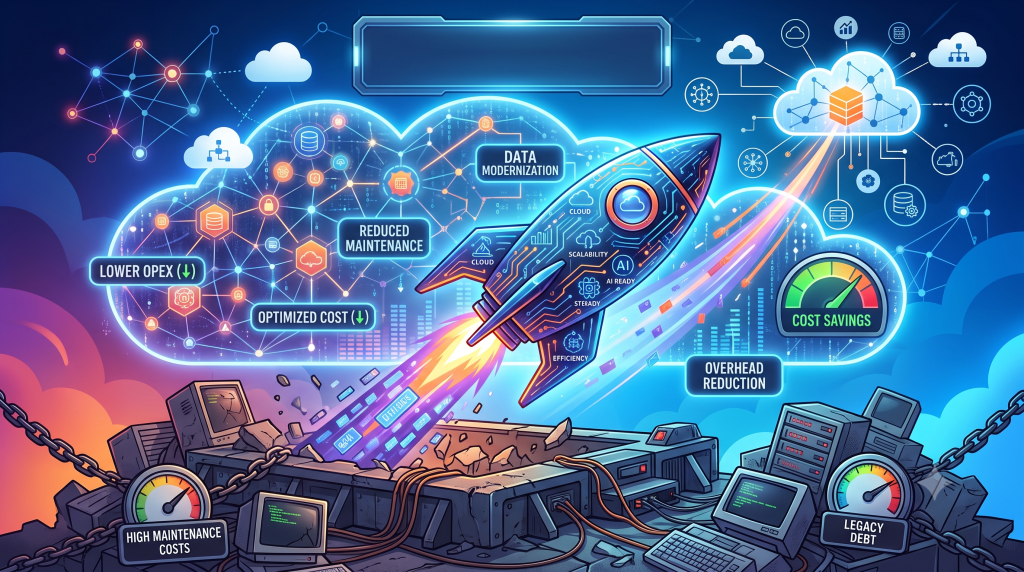
The rapid acceleration of artificial intelligence has exposed a critical vulnerability within the modern enterprise: weak, inflexible data foundations. While global enterprise AI adoption rates currently hover near 98%, an estimated $108 billion in global AI investment is wasted annually due to incompatible and fragmented data environments. For organizations striving to deploy generative AI, agentic workflows, and advanced analytics, achieving production-grade capability requires an aggressive pivot toward legacy data infrastructure modernization. The data indicates that AI is not masking existing data management gaps; rather, it is exposing them, with 58% of organizations remaining trapped in laggard, fragmented stages of data maturity that prevent them from scaling transformative technologies.
💸 The Compounding Financial Drain
The staggering cost of maintaining legacy data infrastructure paralyzes enterprise innovation and actively erodes competitive advantage. Organizations routinely allocate up to 80% of their annual IT budgets solely to support and maintain legacy systems, leaving minimal capital for strategic technological advancement. These aging environments rely on rigid, monolithic frameworks that cannot scale efficiently as enterprise data volumes explode. Traditional relational databases, manual reporting pipelines, and siloed data warehouses incur massive, unsustainable storage and processing expenses when forced to handle modern workloads.
The financial compounding effect is severe. Layering modern AI tools on top of an unmodernized system simply adds new operating burdens without reducing the underlying technical debt. When high-value engineering capacity is consumed by routine maintenance, emergency patching, and mitigating the risks of undocumented dependencies, the return on technology spend flattens. To break this cycle, organizations must pivot toward elastic, cloud-native architectures that significantly reduce total cost of ownership through decoupled storage and compute, while simultaneously automating infrastructure management.
🤖 The Structural Disconnect: The Root of AI Failure
Understanding why AI initiatives fail on legacy data begins with analyzing structural incompatibilities rather than pointing to algorithmic or model limitations. In recent enterprise surveys, 42% of companies reported abandoning their AI initiatives, absorbing an average sunk cost of $7.2 million per failed project. This failure is driven by four distinct architectural roadblocks inherent to legacy systems.
The first critical failure mode is data inaccessibility. Corporate legacy databases typically capture only about 20% of business-critical information in structured formats, leaving the remaining 80%—unstructured documents, flat files, and legacy reporting outputs—entirely out of reach for AI models. Second, legacy architectures suffer from severe integration rigidity. They were never designed to expose data through the flexible, standardized APIs required for modern AI tool calls. When an autonomous agent encounters a legacy system with improperly scoped permissions or an inconsistent schema, the workflow breaks down unpredictably, leaving no observability layer or audit trail to diagnose the failure.
Furthermore, traditional batch-oriented processing introduces latency incompatibility. AI models, particularly those driving autonomous agents, demand instantaneous, context-rich data to function accurately; historical batch processing delays insight and breaks agentic use cases. Finally, legacy platforms suffer from massive governance and security gaps. They struggle to implement the fine-grained data classification, automated discovery, and sensitivity labeling required for secure AI adoption. Without automated data security protocols—such as those enabled by modern tools like Microsoft Purview—organizations risk exposing outdated, sensitive, or heavily regulated information to AI models, creating severe compliance and security liabilities.
| Failure Mode | Legacy Infrastructure Limitation | Modern Cloud Resolution |
| Data Inaccessibility | 80% of unstructured data remains trapped in inaccessible formats. | Unified lakehouse architecture ingests diverse data types natively. |
| Integration Rigidity | Lack of standardized APIs and unpredictable endpoint schemas. | Modular, API-first architecture designed for seamless tool calling. |
| Latency Incompatibility | Batch-processing delays insights by hours or days. | Event-driven architecture provides instantaneous context to AI. |
| Governance Gaps | Manual security auditing and poor access controls. | Automated classification, sensitivity labeling, and zero-trust protocols. |
🏗️ Architecting the Shift: A Modernization Strategy
To resolve these structural bottlenecks, enterprises must design and execute a comprehensive on-prem to cloud data migration strategy. This initiative must transcend the simple “lift-and-shift” replication of existing databases in the cloud; it requires fundamentally re-architecting how data is ingested, processed, governed, and consumed across the organization.
A critical phase of this strategy involves actively decommissioning legacy data silos. Fragmented, on-premises data environments force employees to waste countless hours chasing information across disconnected departments and prevent AI models from accessing a unified, company-wide view of performance. By decommissioning legacy data silos and transitioning to a modern data lakehouse architecture, organizations establish a highly governed, centralized foundation. A lakehouse combines the vast, unstructured storage capabilities of a data lake with the structured governance, ACID transactions, and performance reliability of a traditional data warehouse, seamlessly supporting the massive datasets required for advanced machine learning workloads.
⚙️ Accelerating the Transition with Automated Tooling
For many mature enterprises, decades of complex, proprietary business logic are deeply embedded within legacy Extract, Transform, and Load (ETL) mapping tools. Attempting to migrate this dense logic manually is highly error-prone, resource-intensive, and operationally disruptive. Therefore, leveraging specialized Informatica to AWS migration services has emerged as a critical mechanism to drastically accelerate the modernization timeline.
Engineering teams utilize tools such as the AWS Schema Conversion Tool (SCT) to automate the translation of legacy Informatica ETL scripts into cloud-native equivalents, such as AWS Glue or Amazon Redshift RSQL. By defining precise, global mapping rules for source and target environments, the AWS SCT programmatically processes Informatica XML files, mitigating the risk of human error and translating complex transformations into modern code. Furthermore, third-party optimization frameworks, such as the X2XConverter suite, allow organizations to seamlessly analyze, convert, and validate these mappings, reducing migration timelines and associated costs by up to 90%. This automated transition empowers enterprises to shift away from rigid, proprietary ETL processes and embrace scalable, cloud-native data engineering operations.
| Migration Phase | Legacy ETL Constraint | Automated Cloud Migration Approach (AWS) |
| Assessment | Manual mapping of undocumented dependencies. | Automated analysis of Informatica XML metadata. |
| Code Conversion | High human error rate in rewriting complex SQL/ETL logic. | Programmatic conversion via AWS SCT and third-party tools. |
| Validation | Time-intensive manual data quality reconciliation. | Automated source-to-target integrity validation algorithms. |
| Execution | Protracted deployment cycles with high downtime risk. | CI/CD pipeline integration with up to 90% timeline reduction. |
⚡ The Destination: Achieving Continuous Intelligence
Once complex workloads and logic are successfully migrated to the cloud, the architectural focus must shift entirely to velocity and operational resilience. The modern, AI-driven enterprise requires a real-time data pipeline architecture to feed language models, autonomous agents, and operational dashboards instantaneously.
Unlike legacy systems that process data in overnight batches, a real-time data pipeline architecture utilizes continuous stream processing to ingest, transform, and deliver data precisely as events occur in the physical or digital world. Continuous pipeline monitoring immediately identifies and resolves bottlenecks, ensuring that enterprise analytics platforms always access the freshest, most accurate information possible. This highly dynamic, uninterrupted flow of governed information is what ultimately enables autonomous AI agents to make reliable, context-aware decisions in production environments.
The transition away from aging infrastructure is no longer an optional IT initiative; it is an urgent requirement for corporate survival. By committing to comprehensive modernization, embracing automated cloud migration, and building unified, real-time data pipelines, enterprises can finally eliminate the technical debt that hinders innovation. Ultimately, data must be treated as a highly governed, strategic asset—the foundational bedrock upon which the entire future of enterprise artificial intelligence is built.