
The cloud promise is simple: pay only for what you use. But for many enterprises, the reality is much harsher: you pay for what you provision, whether you use it or not.
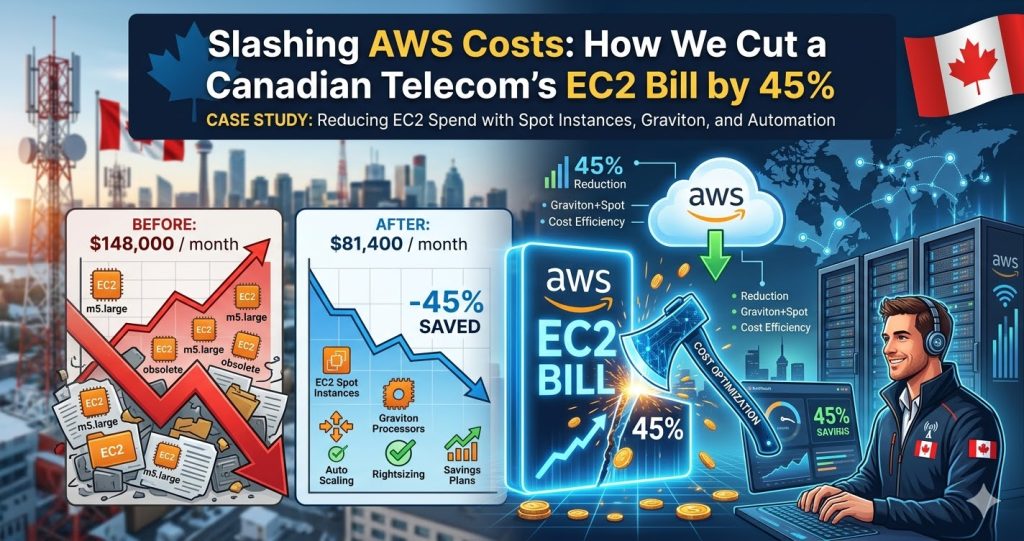
Recently, we partnered with a leading Canadian Telecommunications provider. Over the past few years, they had successfully migrated their mission-critical applications and microservices to AWS. Engineering velocity was up, but so was their monthly invoice. Their Amazon EC2 spend had quietly ballooned into a massive, unpredictable line item that was alarming the CFO.
When they brought TnY Systems in to audit their architecture, we didn’t just look for ways to trim the fat—we fundamentally re-architected how their workloads consumed compute power.
Here is the exact playbook we used to reduce their EC2 compute costs by 45%, combining standard FinOps hygiene with advanced engineering optimizations.
The Problem: The “Lift and Shift” Hangover
When the client initially migrated to AWS, they followed a traditional “lift and shift” approach. If an application required 16 vCPUs on-premise, they provisioned a 16-vCPU instance (m5.4xlarge) in AWS.
Because telecom microservices experience massive traffic spikes during billing cycles and promotions, engineers intentionally over-provisioned resources “just in case.” The result? Hundreds of On-Demand EC2 instances running 24/7 with an average CPU utilization of less than 15%.
It was time to introduce a culture of FinOps.
Phase 1: The “Low-Hanging Fruit” (Standard Cost Savings)
Before re-architecting applications, we stopped the immediate bleeding using standard AWS cost-optimization best practices:
1. Ruthless Right-Sizing
We deployed AWS Compute Optimizer and Datadog to analyze actual memory and CPU utilization over a 30-day period. We discovered that over 60% of their instances were vastly over-provisioned. We aggressively downsized instances (e.g., moving from m5.2xlarge to t3.large or m5.large) without impacting application performance.
2. Compute Savings Plans (CSPs)
The client was running 80% of their workloads on On-Demand pricing. Once we right-sized the environment to establish a new, highly accurate baseline of compute usage, we committed to a 1-Year AWS Compute Savings Plan. This immediately shaved ~30% off the baseline compute costs while retaining the flexibility to change instance families later.
3. Eradicating “Zombie” Infrastructure
Cloud sprawl is real. We automated the termination of idle resources. We deleted thousands of unattached EBS (Elastic Block Store) volumes, wiped obsolete snapshots, and implemented an AWS Instance Scheduler to automatically shut down Dev and QA environments on nights and weekends.
Phase 2: Deep Engineering (Advanced Cost Savings)
Standard practices will save you 20-30%. But to truly optimize a cloud-native microservices architecture, you have to get your hands dirty at the engineering level. Here are the advanced tactics we deployed:
Advanced Tactic 1: The Graviton (ARM) Migration ⚡
Most legacy cloud workloads run on traditional x86 processors (Intel/AMD). However, AWS’s custom-built ARM-based processors—AWS Graviton—offer up to 40% better price performance.
Because the client’s microservices were stateless, containerized, and written in modern languages (Node.js and Python), they were prime candidates for ARM. We refactored their CI/CD pipelines to build multi-architecture Docker images. By migrating their core microservices clusters from 5th-generation Intel instances (m5) to 7th-generation Graviton instances (m7g), we achieved an instant 20% cost reduction per instance, alongside noticeable performance gains.
Advanced Tactic 2: Mixed-Instance ASGs with Spot Fleet Automation 🎯
AWS Spot Instances allow you to bid on spare AWS compute capacity at up to a 90% discount. The catch? AWS can reclaim the instance with just a 2-minute warning.
For the client’s stateless background workers and non-critical data processing microservices, we transitioned away from On-Demand entirely. We configured Auto Scaling Groups (ASGs) with a Mixed Instances Policy.
We set a baseline of 20% On-Demand instances (to guarantee minimum availability).
The remaining 80% of the capacity was fulfilled using Spot Instances.
To prevent outages when AWS reclaims capacity, we configured a “capacity-optimized” allocation strategy. The ASG automatically shifts workloads to instance pools with the most available spare capacity, gracefully handling the 2-minute interruption notices and spinning up replacements before the old nodes die.
Advanced Tactic 3: Mass Storage Modernization (gp2 to gp3) 💾
While technically a storage optimization, EBS volumes are directly attached to EC2 instances and represent a massive hidden cost. The client was still using legacy gp2 volumes, where IOPS performance is tied directly to storage size (meaning engineers were provisioning massive 1TB drives just to get higher IOPS).
We wrote automated scripts to transition all EBS volumes to the newer gp3 standard without any downtime. gp3 separates storage from IOPS, allowing us to provision exactly the throughput we needed. This simple engineering flip reduced EBS storage costs by 20% across the board.
The Results: A Lean, Mean, Telecom Machine
By combining aggressive right-sizing with advanced architectural shifts like Graviton and Spot Fleet automation, the results for our telecom client were staggering:
📉 45% reduction in total monthly EC2 and EBS compute spend.
⚡ Improved application latency by shifting to modern Graviton processors.
🛠️ Established a FinOps Culture: Engineering teams now build with cost-efficiency in mind, utilizing CI/CD pipelines that default to cost-effective ARM architectures.
Is Your Cloud Bill Out of Control?
Treating the cloud like an on-premise data center is the fastest way to burn through your IT budget. Modern cloud architecture requires continuous optimization, deep observability, and a strict FinOps framework.
Are you ready to stop paying for cloud waste? At TnY Systems, we specialize in enterprise cloud architecture, legacy modernization, and aggressive FinOps optimization.
Connect with our Principal Architects today for a comprehensive Technical Cloud Audit, and let’s turn your cloud infrastructure into a competitive advantage.