As enterprise organizations scale generative AI copilots, customer support agents, and autonomous analytics workflows into production, data privacy and regulatory compliance have transitioned from legal afterthoughts to core architectural requirements.
Historically, enterprise data privacy centered on securing static data stores—protecting relational database tables behind virtual private clouds (VPCs), configuring TLS encryption in transit, and managing Role-Based Access Control (RBAC). However, Large Language Models (LLMs) introduce an entirely new paradigm: dynamic, nondeterministic inference pipelines where proprietary corporate data, customer conversations, and personal identifiable information (PII) are continuously serialized into unstructured prompt context windows and distributed vector databases.
According to regulatory analyses in Managing LLM Data Privacy and Compliance in the Enterprise and Requesty’s 2026 EU AI Compliance Report, organizations deploying enterprise AI must comply with overlapping, aggressive regulatory mandates—including the European Union AI Act, GDPR Article 48 data sovereignty rules, HIPAA for protected health information (PHI), and SOC 2 Type II trust principles. Violations resulting from prompt leakage or training data absorption carry severe financial penalties and reputational damage.
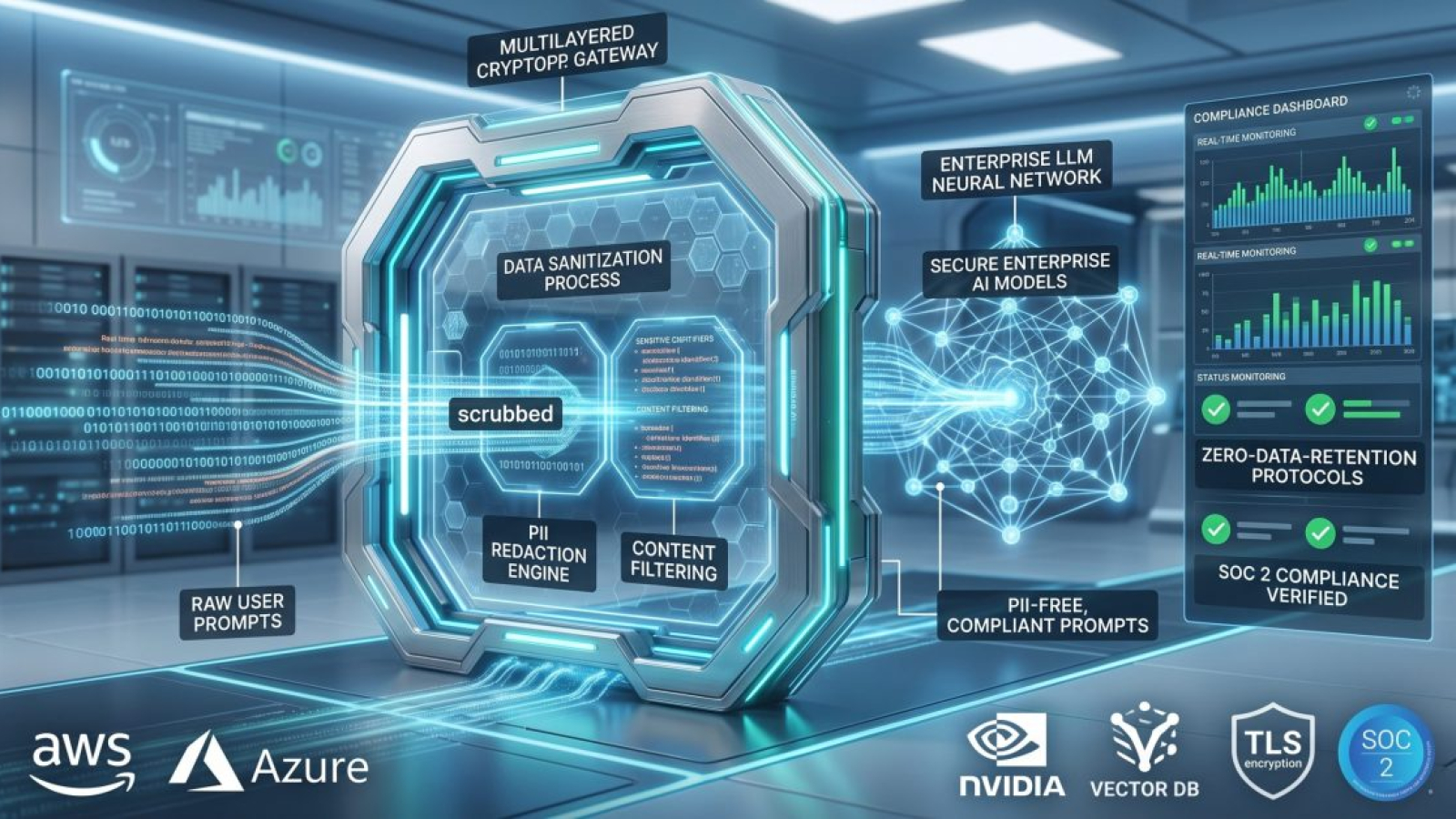
Achieving enterprise-grade LLM compliance requires building a Zero-Trust AI Gateway that decouples internal applications from foundational model providers while enforcing in-flight data redaction, zero data retention, and immutable auditability.
This technical guide outlines the engineering blueprint for securing enterprise LLM pipelines against data leakage and regulatory non-compliance.
1. Threat Vectors in Enterprise LLM Architectures
Securing generative AI requires identifying where sensitive data can escape corporate boundaries:
┌────────────────────────────────────────────────────────────────────────┐
│                   ENTERPRISE LLM DATA EXPOSURE VECTORS                 │
│                                                                        │
│  [User / Employee] ──▶ Prompt Injection / Direct PII Input             │
│                              │                                         │
│                              ▼                                         │
│  [Retrieval (RAG)] ──▶ Over-Permissioned Chunks (Cross-Tenant Leakage) │
│                              │                                         │
│                              ▼                                         │
│  [Third-Party Model]─▶ Training Set Absorption & Persistent Caching    │
│                              │                                         │
│                              ▼                                         │
│  [Model Completion]─▶ Hallucinated PII / Unredacted Downstream Logs    │
└────────────────────────────────────────────────────────────────────────┘
- Third-Party Model Retention: Standard consumer API tiers often log prompts for 30 days or reserve rights to train future model iterations, violating enterprise non-disclosure agreements and data residency laws.
- Context Window Cross-Contamination: In multi-tenant enterprise RAG systems, inadequate metadata filtering allows employees in low-clearance roles to retrieve executive compensation records or unannounced acquisition details.
- Indirect Prompt Injection: Malicious or unvetted external documents ingested into the vector database can contain adversarial instructions that command the model to exfiltrate session data over external webhooks.
2. Core Architectural Pillars of LLM Data Privacy
Building a compliant enterprise AI system requires four foundational engineering controls, as detailed in NeuralTrust’s Zero Data Retention Standard:
| Pillar | Technical Mechanism | Primary Compliance Target |
| Stateless AI Gateway | Centralized proxy intercepting all internal LLM API traffic | Centralized auditability, policy enforcement |
| In-Flight PII Redaction | High-speed Named Entity Recognition (NER) and tokenization | GDPR / HIPAA / CCPA compliance |
| Zero Data Retention (ZDR) | Cryptographic API headers & private VPC endpoints (AWS PrivateLink) | SOC 2 Type II, EU AI Act data sovereignty |
| Vector RBAC & Metadata Isolation | Dynamic row-level security on vector embeddings (pgvector / Qdrant) | Internal confidentiality, multi-tenant isolation |
3. Step-by-Step Technical Implementation
┌─────────────────────────────────────────────────────────────────────────────────┐
│                          ENTERPRISE ZERO-TRUST AI GATEWAY                       │
│                                                                                 │
│  ┌─────────────────┐       ┌──────────────────────────────────────────────┐     │
│  │ Internal App /  │──────▶│ 1. PII Redaction Engine (NER Scrubbing)      │     │
│  │ Agent Caller    │       └──────────────────────┬───────────────────────┘     │
│  └─────────────────┘                              ▼                             │
│                           ┌──────────────────────────────────────────────┐      │
│                           │ 2. Policy & RBAC Validation (JWT Claims)     │      │
│                           └──────────────────────┬───────────────────────┘      │
│                                                  ▼                             │
│                           ┌──────────────────────────────────────────────┐      │
│                           │ 3. Prompt Firewall (Injection & Canary Check)│      │
│                           └──────────────────────┬───────────────────────┘      │
│                                                  ▼                             │
│                           ┌──────────────────────────────────────────────┐      │
│                           │ 4. ZDR Model Router (PrivateLink / TLS 1.3)  │      │
│                           └──────────────────────┬───────────────────────┘      │
│                                                  │                              │
│                                                  ▼                              │
│                                   ┌───────────────────────────────┐             │
│                                   │ Private Model Endpoint (AWS / │             │
│                                   │ Azure / On-Prem / Anthropic)  │             │
│                                   └───────────────────────────────┘             │
└─────────────────────────────────────────────────────────────────────────────────┘
Step 1: Deploying a Stateless AI Gateway with In-Flight PII Redaction
Never allow internal applications to query LLM APIs directly. Route all traffic through a centralized stateless gateway that scrubs PII using high-throughput Named Entity Recognition (NER) models before payloads leave your infrastructure:
Python
# Enterprise LLM Gateway In-Flight PII Redaction Pattern
import re
from typing import Dict, Any, Tuple

class ComplianceAIGateway:
    def __init__(self):
        # High-confidence PII regex tokenizers
        self.patterns = {
            "EMAIL": re.compile(r'[\w\.-]+@[\w\.-]+\.\w+'),
            "SSN": re.compile(r'\b\d{3}-\d{2}-\d{4}\b'),
            "CREDIT_CARD": re.compile(r'\b(?:\d[ -]*?){13,16}\b'),
            "API_KEY": re.compile(r'(?i)(?:bearer|api[_-]?key|secret)\s*[:=]\s*([a-zA-Z0-9_\-\.]{16,})')
        }

    def redact_payload(self, text: str) -> Tuple[str, Dict[str, str]]:
        """
        Replaces sensitive entities with reversible pseudonyms
        stored exclusively in ephemeral session memory.
        """
        token_map = {}
        redacted_text = text

        for entity_type, pattern in self.patterns.items():
            matches = pattern.findall(redacted_text)
            for i, match in enumerate(matches):
                placeholder = f"<{entity_type}_{i+1}>"
                token_map[placeholder] = match
                redacted_text = redacted_text.replace(match, placeholder)

        return redacted_text, token_map

    def restore_completion(self, completion: str, token_map: Dict[str, str]) -> str:
        """Restores pseudonyms in the completion text before returning to the caller."""
        restored = completion
        for placeholder, original in token_map.items():
            restored = restored.replace(placeholder, original)
        return restored
As demonstrated in Gravitee’s Automated Data Redaction Architecture, tokenizing sensitive entities into reversible pseudonyms (<CUSTOMER_1>, <SSN_1>) preserves the semantic reasoning capabilities of the model while ensuring zero raw PII reaches provider servers.
Step 2: Enforcing Zero Data Retention (ZDR) Contracts
Verify that your enterprise agreements and API parameters activate provider-level Zero Data Retention:
- Stateless API Invocations: Use enterprise endpoints that legally forbid vendor training and bypass default logging mechanisms (e.g., Azure OpenAI Service zero-logging agreements, AWS Bedrock private invocations, Anthropic Commercial Terms).
- Canary Token Insertion: Periodically inject synthetic “canary tokens” (unique cryptographic strings) into test prompts and continuously scan public web indexes to verify provider endpoints are not leaking prompt context into shared caches.
Step 3: Multi-Tenant Vector Database Isolation
When storing embeddings in pgvector, Qdrant, or Snowflake Cortex, enforce strict tenant isolation using cryptographically verified user claims:
SQL
-- Multi-Tenant Vector Isolation in PostgreSQL with pgvector
CREATE TABLE IF NOT EXISTS corporate_knowledge_vectors (
    id UUID PRIMARY KEY DEFAULT gen_random_uuid(),
    tenant_id VARCHAR(64) NOT NULL,
    clearance_level INT NOT NULL DEFAULT 1,
    document_chunk TEXT NOT NULL,
    embedding VECTOR(1536) NOT NULL
);

-- Enforce Row-Level Security based on active session JWT claims
ALTER TABLE corporate_knowledge_vectors ENABLE ROW LEVEL SECURITY;

CREATE POLICY tenant_clearance_isolation_policy ON corporate_knowledge_vectors
    FOR SELECT
    USING (
        tenant_id = CURRENT_SETTING('request.jwt.claim.tenant_id', true)
        AND clearance_level <= CURRENT_SETTING('request.jwt.claim.clearance', true)::INT
    );
4. Regulatory Alignment: Navigating the EU AI Act & HIPAA
Operating compliant generative AI in 2026 requires understanding specific regulatory obligations:
- EU AI Act Transparency & Governance: Systems classified as High-Risk AI must maintain comprehensive technical documentation, continuous risk assessments, and verifiable human oversight mechanisms. Unchecked autonomous decision systems operating without logging violate Article 14 mandates.
- HIPAA Business Associate Agreements (BAAs): Processing Protected Health Information (PHI) through LLMs requires executed BAAs with cloud infrastructure providers, dedicated VPC networking (e.g., AWS PrivateLink), and full audit logging of every query containing patient identifiers.
- GDPR Article 17 (“Right to be Forgotten”): Vector databases present a unique challenge: when a user requests data deletion, their embeddings must be purged from high-dimensional indexes. Modern architectures maintain granular document-to-vector mapping tables to execute deterministic deletions without re-indexing the entire corpus.
5. Enterprise Compliance Checklist for Generative AI
| Compliance Domain | Architectural Requirement | Production Status |
| Ingress Sanitation | In-flight NER PII scrubbing on all outgoing prompts | Required |
| Model Ingress | Zero Data Retention (ZDR) verified on provider contracts | Required |
| Network Security | Models queried via private VPC endpoints (no public internet transit) | Required |
| Vector Isolation | Row-level security (RLS) and tenant claim enforcement | Required |
| Auditability | Tamper-resistant logging of query metadata and token counts | Required |
| Data Residency | Models hosted in explicit geographic regions (e.g., EU-only or US-only) | Required |
Architect Compliant Enterprise AI with TnY Systems
Deploying production-grade generative AI while satisfying stringent compliance and security standards requires deep engineering expertise across cloud infrastructure, lakehouses, and model gateways. With over 20 years of hands-on data warehousing, cloud architecture, and secure pipeline leadership, TnY Systems designs and implements zero-trust AI foundations, private RAG pipelines, and compliant model gateways across AWS, Snowflake, and multi-cloud stacks.
Looking to ensure your enterprise AI stack is secure and compliant? Schedule an architectural review with TnY Systems to assess your security posture and design your production-ready AI governance roadmap.