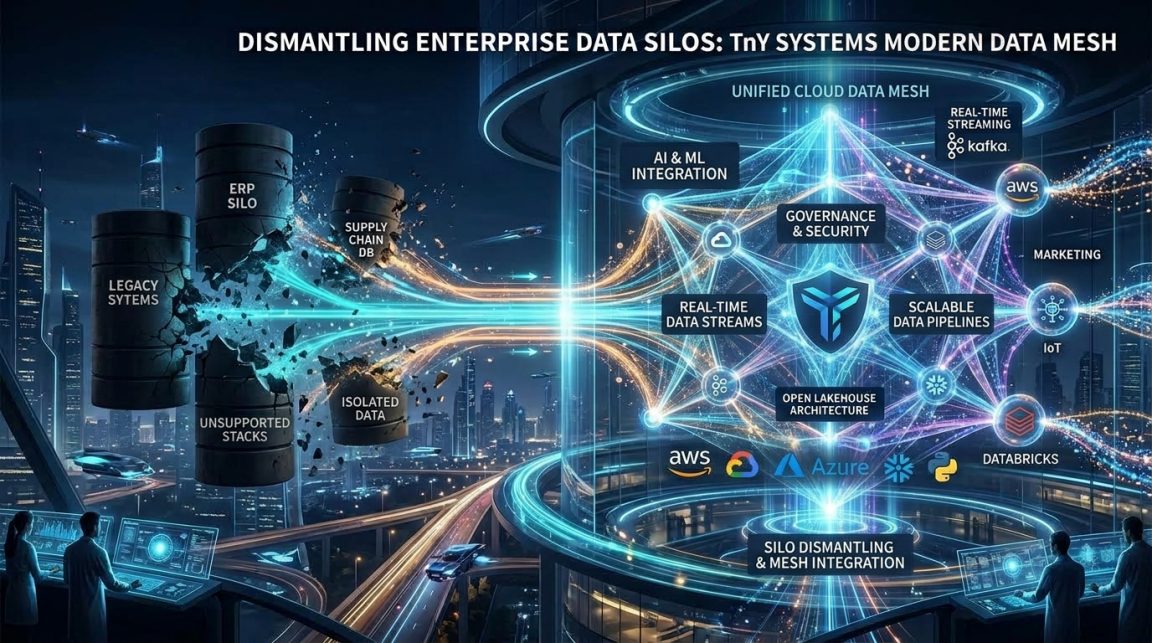
In mature enterprise organizations, data silos rarely emerge from malicious design; they are the natural byproduct of rapid organizational growth, departmental autonomy, and historical mergers and acquisitions. Sales deployed its own CRM and reporting database; Finance procured a specialized planning warehouse; Operations maintained on-premises relational databases; and Product teams built custom operational datastores.
Over time, this fragmentation calcifies into an architectural bottleneck. According to enterprise modernization benchmarks highlighted in Kagool’s Enterprise Cloud Modernization Guide and Arctiq’s Lakehouse Architecture Blueprint, large enterprises operate an average of 12 to 18 isolated data repositories. This fragmentation leads to pervasive “metric drift”—where executive teams receive three contradictory versions of monthly recurring revenue (MRR) or customer churn—while redundant batch ETL pipelines multiply cloud storage and maintenance costs.
Worse still, data silos cripple enterprise artificial intelligence initiatives. An autonomous AI agent or predictive model cannot deliver comprehensive business value when customer interaction history, billing records, and product telemetry reside in isolated, mutually inaccessible environments.
Decommissioning legacy data silos requires more than simply copying data into a central bucket. It demands a structured architectural migration to an open, governed data lakehouse.
This guide details the strategic framework and technical steps required to dismantle legacy data silos without disrupting operational workflows.
1. The Anatomy and True Cost of Enterprise Data Silos
Data silos manifest across technical, operational, and financial dimensions:
THE SILOED ENTERPRISE (Fractured Context, Redundant ETL):
┌────────────────────┐    ┌────────────────────┐    ┌────────────────────┐
│ Finance Silo       │    │ Sales Silo         │    │ Product Silo       │
│ (Legacy On-Prem DB)│    │ (Cloud SaaS / CRM) │    │ (NoSQL / MongoDB)  │
└─────────┬──────────┘    └─────────┬──────────┘    └─────────┬──────────┘
          │ (Nightly Batch)         │ (Custom Script)         │ (Ad-hoc API)
          ▼                         ▼                         ▼
┌────────────────────┐    ┌────────────────────┐    ┌────────────────────┐
│ Custom Fin BI Mart │    │ Salesforce Reports │    │ Product Analytics  │
└────────────────────┘    └────────────────────┘    └────────────────────┘
Result: 3 Contradictory Metrics, Zero Cross-Functional Context, Massive Operational Overhead

THE UNIFIED LAKEHOUSE MESH (Zero-Copy, Single Source of Truth):
┌────────────────────────────────────────────────────────────────────────┐
│               UNIFIED ENTERPRISE DATA FOUNDATION (SNOWFLAKE / AWS)     │
│                                                                        │
│  [Finance CDC] ──┐                                                     │
│  [Sales APIs]   ──┼──▶ [Bronze Layer] ──▶ [Silver Layer] ──▶ [Gold Marts│
│  [Product Logs] ──┘      (Raw Parquet)     (Cleaned dbt)     (Semantic)│
│                                                                        │
│  Enforced Governance: Role-Based Access Control, Lineage & Open Table  │
└────────────────────────────────────────────────────────────────────────┘
The Three Compounding Costs of Data Silos:
- Engineering Overhead: Data engineering teams spend up to 60% of their sprints building and maintaining point-to-point “spaghetti” pipelines just to synchronize disparate systems.
- Governance and Compliance Liabilities: Departmental silos obscure data lineage. Under regulations like GDPR, CCPA, or HIPAA, organizations cannot reliably fulfill “Right to be Forgotten” requests across unmapped departmental databases.
- AI Context Blindness: Foundation models and Retrieval-Augmented Generation (RAG) agents fail when restricted to single-domain context, resulting in hallucinations and inaccurate outputs as analyzed in Kestra’s Data Lakehouse Architecture Guide.
2. The 4-Phase Framework for Decommissioning Silos
Decommissioning data silos is an evolutionary process that avoids high-risk “rip-and-replace” disruptions:
| Phase | Core Objective | Key Deliverables |
| Phase 1: Silo Discovery & Inventory | Map data producers, consumers, and metric definitions | Lineage catalog, data dictionary, orphan asset list |
| Phase 2: Semantic Foundation | Establish unified lakehouse storage and declarative schemas | Medallion architecture (Bronze/Silver/Gold), dbt models |
| Phase 3: Dual-Run Ingestion | Continuous log-based CDC from silos to the unified platform | Sub-second replication (Kafka/Debezium/AWS DMS) |
| Phase 4: Consumption Cutover & Deprecation | Redirect BI, APIs, and AI models; archive and decommission | Hardware shutdown, license termination, Glacier cold archival |
3. Step-by-Step Technical Execution
Step 1: Automated Asset Discovery and Orphan Identification
Before attempting migration, analyze historical database access logs to discover which tables and queries are actively utilized. In typical enterprise databases, 30% to 50% of legacy tables have not experienced a read operation in over 180 days.
SQL
-- Identifying Inactive or Orphaned Tables in Legacy Analytical Schemas
SELECT
    schemaname,
    relname AS table_name,
    pg_size_pretty(pg_total_relation_size(relid)) AS total_size,
    seq_scan + idx_scan AS total_reads,
    last_seq_scan,
    last_idx_scan
FROM pg_stat_user_tables
WHERE (seq_scan + idx_scan) = 0
   OR (last_seq_scan < NOW() - INTERVAL '180 days' AND last_idx_scan < NOW() - INTERVAL '180 days')
ORDER BY pg_total_relation_size(relid) DESC;
Action: Quarantine inactive tables directly into low-cost cold storage rather than migrating digital debt into modern cloud warehouses.
Step 2: Harmonizing Semantic Contracts with dbt
Siloed teams often define identical metrics using conflicting logic. For example, Sales defines “Active Customer” as any account with an open opportunity, while Finance defines it strictly by processed subscription revenue.
Resolve metric fragmentation by establishing centralized, version-controlled semantic definitions using dbt Semantic Layer or centralized SQL models:
SQL
-- models/marts/core/dim_enterprise_customers.sql
{{ config(
    materialized='incremental',
    unique_key='customer_id',
    cluster_by=['signup_date', 'subscription_tier']
) }}

WITH finance_billing AS (
    SELECT customer_id, SUM(billed_amount) AS ltv, MAX(billing_date) AS last_payment_date
    FROM {{ ref('stg_finance__invoices') }}
    GROUP BY customer_id
),
sales_crm AS (
    SELECT customer_id, account_owner, industry, region
    FROM {{ ref('stg_salesforce__accounts') }}
),
product_usage AS (
    SELECT customer_id, MAX(event_timestamp) AS last_active_at, COUNT(DISTINCT session_id) AS total_sessions
    FROM {{ ref('stg_telemetry__user_events') }}
    GROUP BY customer_id
)

SELECT
    s.customer_id,
    s.account_owner,
    s.industry,
    s.region,
    COALESCE(f.ltv, 0.0) AS customer_lifetime_value,
    f.last_payment_date,
    p.last_active_at,
    p.total_sessions,
    -- Canonical business logic unifying previously contradictory definitions
    CASE
        WHEN f.last_payment_date >= CURRENT_DATE - INTERVAL '30 days'
         AND p.last_active_at >= CURRENT_DATE - INTERVAL '14 days' THEN 'Active_Engaged'
        WHEN f.last_payment_date >= CURRENT_DATE - INTERVAL '30 days' THEN 'Active_At_Risk'
        ELSE 'Churned'
    END AS unified_customer_lifecycle_status
FROM sales_crm s
LEFT JOIN finance_billing f ON s.customer_id = f.customer_id
LEFT JOIN product_usage p ON s.customer_id = p.customer_id
Step 3: Zero-Impact Data Ingestion via Change Data Capture (CDC)
Rather than executing resource-intensive batch queries that lock production departmental databases, deploy non-intrusive log-based CDC agents (e.g., Debezium, AWS DMS, Striim) to stream row-level deltas continuously into cloud object storage (S3/Iceberg).
Step 4: Governed Cutover and Legacy Deprecation
As outlined in VeloAstra’s Modern Data Platform Architecture Guide, execute consumer redirection iteratively by domain:
- Redirect BI & Dashboards: Repoint Tableau, Power BI, and Looker data sources from legacy silos to the unified Gold semantic mart.
- Expose Self-Service Data Products: Provide departmental stakeholders with governed SQL access via Snowflake or Amazon Athena with role-based masking.
- Revoke Silo Write Access & Shutdown: Set legacy silo databases to read-only for 14 days to catch undeclared dependencies, export compliance cold archives, and decommission underlying hardware.
4. Organizational Change Management: Preventing New Silos
Technical architecture alone cannot prevent data silos from re-emerging if organizational incentives remain unchanged:
- Establish a Federated Data Mesh Mindset: Treat data as a product. Departmental teams retain domain ownership of their business logic while publishing standardized data products to the central cloud platform.
- Universal Data Cataloging: Deploy automated metadata discovery tools (e.g., Atlan, Alation, or Snowflake Horizon) so business analysts can discover existing curated datasets before building duplicate tables.
- Automated Access Workflows: Eliminate bureaucratic multi-week ticketing queues for dataset access by implementing automated, role-based request workflows.
5. Summary & Modernization Milestone Checklist
| Milestone | Timeframe | Core Deliverables | Success Criteria |
| Discovery & Audit | Weeks 1–3 | Lineage mapping & orphan table detection | Identification of 30%+ inactive tables |
| Semantic Modeling | Weeks 4–7 | Canonical dbt models & metric definitions | Universal agreement on core business KPIs |
| CDC Lakehouse Ingestion | Weeks 8–10 | Non-blocking streaming replication | Sub-minute replication latency to cloud S3 |
| BI & API Cutover | Weeks 11–13 | Downstream dashboard redirection | Zero dependency on legacy departmental marts |
| Hardware Decommissioning | Week 14+ | Cold archive to S3 Glacier & server power-down | Full recovery of legacy licensing and hosting costs |
Decommission Legacy Silos with TnY Systems
Dismantling enterprise data silos without operational disruption requires extensive architectural leadership. With over 20 years of hands-on data warehousing, legacy ETL migration, and cloud lakehouse engineering experience, TnY Systems designs and executes comprehensive data consolidation strategies across AWS, Snowflake, and hybrid multi-cloud environments.
Ready to eliminate data silos and build a unified enterprise data foundation? Schedule an architecture consultation with TnY Systems to evaluate your current data estate and design your modernization roadmap.