In modern enterprise data platforms, latency is no longer a technical inconvenience—it is a direct business constraint. For decades, organizations structured analytics around scheduled overnight batch windows. Operational systems recorded events during business hours, ETL jobs ran at 2:00 AM, and executive dashboards updated by sunrise.
However, as highlighted in technical analyses from Software Modernization Services on Real-Time Data Pipeline Architecture, batch architectures create an inherent operational blind spot: over 32% of organizations take hours just to discover data pipeline failures, while critical operational applications—such as dynamic pricing, fraud mitigation, autonomous AI agents, and personalized customer interactions—require decisions within milliseconds of event generation.
Achieving this “Active Intelligence” state requires shifting from periodic batch extractions to continuous event-driven stream processing.
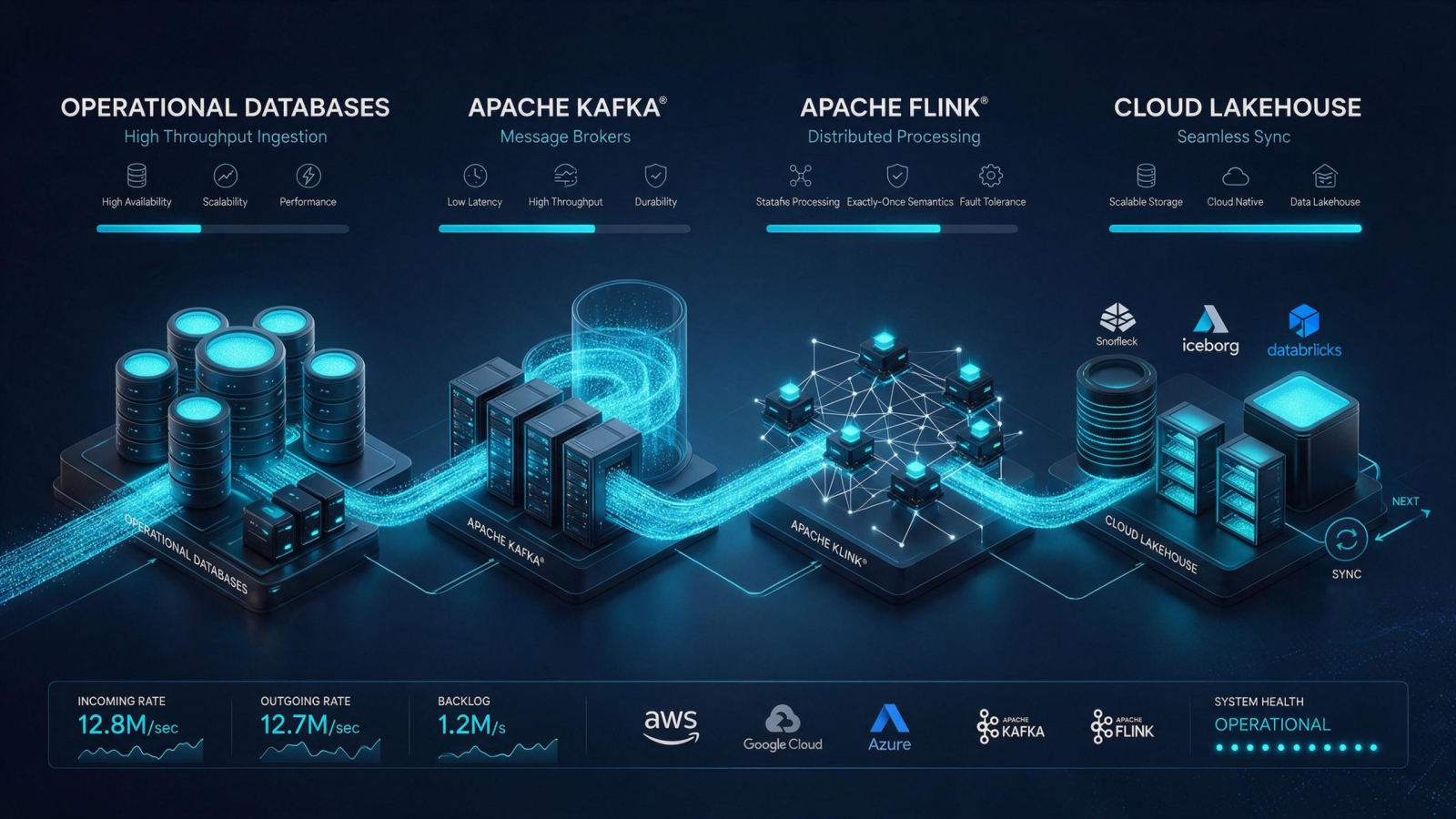
This guide delivers an architectural blueprint for engineering a scalable, fault-tolerant real-time data pipeline leveraging Change Data Capture (CDC), event brokers (Apache Kafka), stream processing engines (Apache Flink), and modern cloud lakehouses.
1. The Architectural Shift: Batch vs. Event-Driven Streaming
Traditional batch ETL and modern real-time streaming operate under fundamentally different data assumptions:
┌────────────────────────────────────────────────────────────────────────┐
│                   BATCH ETL VS. EVENT-DRIVEN STREAMING                 │
│                                                                        │
│  BATCH:                                                                │
│  [Source DB] ──(Nightly Dump)──▶ [Staging] ──(Heavy Transform)──▶ [DW] │
│  Latency: 12 – 24 Hours | High Peak Compute | Stale Downstream State   │
│                                                                        │
│  STREAMING:                                                            │
│  [Source DB] ──(Log CDC)──▶ [Kafka/MSK] ──(Flink SQL)──▶ [Lakehouse]   │
│  Latency: Sub-Second | Predictable Compute | Continuous Fresh State    │
└────────────────────────────────────────────────────────────────────────┘
| Dimension | Legacy Batch ETL | Real-Time Streaming Pipeline |
| Data Delivery | Discrete bounded chunks (daily/hourly) | Continuous unbounded event streams |
| Compute Profile | Massive burst spikes during batch windows | Flat, predictable compute consumption |
| System Coupling | Tight point-to-point database queries | Loose decoupling via event pub/sub brokers |
| Downstream Freshness | Stale (T-1 day) | Instantaneous (sub-second to seconds) |
| Failure Recovery | Re-run entire batch job from scratch | Checkpoint-based replay from stream offset |
2. Core Building Blocks of a Modern Streaming Architecture
An enterprise streaming data stack consists of four decoupled layers:
┌────────────────────────────────────────────────────────────────────────┐
│               ENTERPRISE REAL-TIME DATA PIPELINE LAYERS                │
│                                                                        │
│  ┌──────────────────────────────────────────────────────────────────┐  │
│  │ 1. INGESTION: Log-Based CDC (Debezium, AWS DMS, Striim)          │  │
│  └─────────────────────────────────┬────────────────────────────────┘  │
│                                    ▼                                   │
│  ┌──────────────────────────────────────────────────────────────────┐  │
│  │ 2. STORAGE & TRANSPORT: Event Broker (Apache Kafka, AWS MSK)     │  │
│  └─────────────────────────────────┬────────────────────────────────┘  │
│                                    ▼                                   │
│  ┌──────────────────────────────────────────────────────────────────┐  │
│  │ 3. STATEFUL STREAM PROCESSING: (Apache Flink, Spark Streaming)   │  │
│  └─────────────────────────────────┬────────────────────────────────┘  │
│                                    ▼                                   │
│  ┌──────────────────────────────────────────────────────────────────┐  │
│  │ 4. SINK & SERVING: Lakehouse & Real-Time Stores (Iceberg, Pin)   │  │
│  └──────────────────────────────────────────────────────────────────┘  │
└────────────────────────────────────────────────────────────────────────┘
Layer 1: Zero-Impact Ingestion via Log-Based CDC
Traditional polling queries (SELECT * FROM table WHERE updated_at > last_sync) place severe locks and I/O burdens on production OLTP databases. Modern architectures utilize Log-Based Change Data Capture (CDC), reading directly from database transaction logs (PostgreSQL WAL, MySQL binlog, Oracle Redo). This captures every INSERT, UPDATE, and DELETE event with zero overhead on query execution threads.
Layer 2: Scalable Pub/Sub Event Transport
Apache Kafka (or managed AWS MSK) serves as the centralized, immutable event log. Incoming database events are published to partitioned topics, decoupling data producers from downstream consumers and ensuring resilient replayability.
Layer 3: Stateful Stream Processing with Apache Flink
As detailed in Streamkap’s Flink & Kafka Guide, modern streaming platforms favor Apache Flink over micro-batching due to its true event-driven runtime, low latency, and robust state management. Flink handles out-of-order events using watermarks and executes continuous sliding or tumbling aggregations:
SQL
-- Example: Apache Flink SQL Stateful Window Aggregation
SELECT
    user_id,
    TUMBLE_START(event_time, INTERVAL '5' MINUTE) AS window_start,
    COUNT(*) AS total_transactions,
    SUM(transaction_amount) AS total_volume
FROM raw_payment_events
/* Define watermark strategy to handle network latency & clock drift */
WATERMARK FOR event_time AS event_time - INTERVAL '15' SECOND
GROUP BY
    user_id,
    TUMBLE(event_time, INTERVAL '5' MINUTE);
Layer 4: Open Table Formats & Serving Layer
Processed streaming records are written directly to open lakehouse formats like Apache Iceberg or Delta Lake stored on cloud object storage (Amazon S3). Modern lakehouse engines support ACID transactions and partition evolution, making real-time streaming data immediately queryable by Snowflake, Trino, and Amazon Athena without duplicate storage layers.
3. Engineering for Resilience: Tackling Common Pitfalls
Transitioning to real-time architectures introduces distributed systems challenges that require intentional design:
- Exactly-Once Semantics (EOS): Ensure end-to-end exactly-once processing by combining Kafka transactional producers with Flink’s Two-Phase Commit (
2PC) sink protocol. - Schema Drift Governance: Implement a centralized Schema Registry (e.g., Confluent Schema Registry or AWS Glue Schema Registry) using Avro or Protobuf. Strictly reject producer events that violate backward compatibility to prevent downstream pipeline crashes.
- Backpressure & Spillover Management: Configure auto-scaling worker groups and alert thresholds when consumer lag exceeds predefined SLAs.
4. Business Impact & Production Use Cases
Organizations that modernize from batch to real-time unlock transformative operational capabilities:
- Real-Time Fraud Prevention: Financial transactions are evaluated against historical behavioral profiles in sub-second windows rather than post-settlement audits.
- Dynamic Inventory & Supply Chain: Logistics operations reroute shipments instantly based on IoT sensor alerts, warehouse telemetry, and live traffic data.
- Governed Context for Generative AI: Autonomous agentic workflows retrieve live transactional state rather than operating on stale T-1 day snapshots.
5. Summary & Modernization Checklist
| Phase | Milestone | Primary Deliverable |
| Phase 1: Ingestion Audit | Debezium / CDC deployment | Non-blocking transaction log replication to Kafka |
| Phase 2: Schema Governance | Schema Registry integration | Strict Avro/Protobuf data contracts enforced |
| Phase 3: Stream Processing | Flink pipeline deployment | Sub-second event transformation & window aggregations |
| Phase 4: Lakehouse Sync | Iceberg / S3 integration | Unified batch + streaming storage layer |
Architect Your Real-Time Streaming Foundation with TnY Systems
Migrating from monolithic batch ETL to scalable real-time streaming requires seasoned infrastructure design. With over 20 years of hands-on data warehousing, cloud architecture, and pipeline modernization experience, TnY Systems designs resilient, high-throughput streaming systems using Kafka, Apache Flink, AWS MSK, and Snowflake.
Ready to modernize your data pipelines for active intelligence? Schedule an architecture consultation with TnY Systems to evaluate your current data stack and design your real-time modernization roadmap.