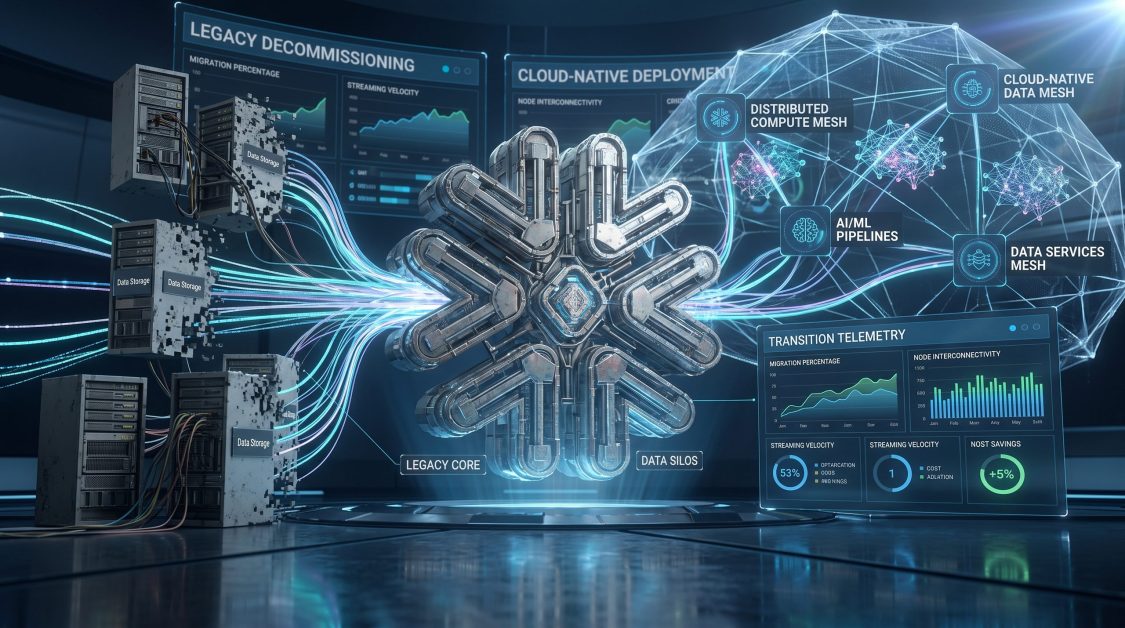
Enterprise technology leaders face a paradox: while corporate mandates demand rapid deployment of generative AI copilots, real-time analytics, and automated decision engines, underlying enterprise data remains trapped in legacy on-premises databases, proprietary ETL tools, and fragmented departmental silos.
This condition—the Legacy Trap—occurs when maintaining aging data infrastructure consumes up to 70% of engineering bandwidth, leaving minimal resources for innovation. According to industry analyses compiled in Softweb Solutions’ Cloud Migration Approaches, over 50% of enterprises are prioritizing managed cloud data platforms to accelerate business agility, yet fewer than one-third of enterprise data workloads have completed migration due to legacy dependencies, monolithic ETL codebases, and data governance concerns.
Without a structured modernization strategy, attempting to layer modern AI agents or real-time analytics on top of legacy data foundations leads to data quality degradation, security vulnerabilities, and project abandonment.
This guide provides an architectural blueprint for modernizing legacy data infrastructure, decommissioning obsolete silos, and executing phased, zero-downtime migrations to cloud-native platforms.
1. Why AI and Modern Analytics Fail on Legacy Data
Modern AI models and analytical platforms require high-throughput streaming ingestion, standardized semantic schemas, and granular metadata lineage. Legacy environments typically exhibit three architectural failure modes:
┌────────────────────────────────────────────────────────────────────────┐
│                        THE LEGACY TRAP BOTTLENECKS                     │
│                                                                        │
│  ┌──────────────────────┐  ┌──────────────────────┐  ┌──────────────┐  │
│  │ Batch Latency & Staleness │  │ Proprietary Silos    │  │ Dark Data &  │  │
│  │ (Overnight batch runs │  │ (Informatica/SSIS,   │  │ Broken       │  │
│  │ stale for AI context)│  │ on-prem mainframes)  │  │ Lineage      │  │
│  └──────────┬───────────┘  └──────────┬───────────┘  └──────┬───────┘  │
│             │                         │                     │          │
│             └─────────────────────────┼─────────────────────┘          │
│                                       ▼                                │
│                     ┌───────────────────────────────────┐              │
│                     │ INCOMPATIBLE WITH REAL-TIME AI,   │              │
│                     │ RAG PIPELINES & CLOUD DATA WAREHOUSES │          │
│                     └───────────────────────────────────┘              │
└────────────────────────────────────────────────────────────────────────┘
- Batch Latency vs. Active Intelligence: Legacy data warehouses rely on rigid, nightly batch windows. Generative AI and real-time operational workflows require sub-second Change Data Capture (CDC) and event-driven data feeds.
- Brittle Custom Scripts & Vendor Lock-In: Decades-old stored procedures, SSIS packages, and proprietary transformation scripts create unmaintainable logic where minor schema changes trigger widespread pipeline failures.
- Ungoverned Data Quality: Lack of modern data observability means schema drift and corrupted records propagate into downstream models unnoticed.
2. The 4 Migration Strategies: Choosing the Right Approach
As outlined in Teradata’s Cloud Migration Framework, choosing the migration path requires balancing speed, risk, and long-term maintainability:
| Strategy | Description | Best For | Risk Profile |
| Rehosting (Lift & Shift) | Moving on-prem VMs and databases directly to cloud IaaS without architectural modification. | Rapid data center exit deadlines | High ongoing operational cost; fails to capture cloud-native elasticity |
| Replatforming (Move & Improve) | Migrating database workloads to managed cloud engines (e.g., self-hosted Postgres $\rightarrow$ Amazon Aurora or Snowflake) with minimal code rewrites. | Mid-tier analytical databases | Moderate effort; delivers managed scaling without full application redesign |
| Refactoring (Cloud-Native Redesign) | Re-architecting legacy batch pipelines into modern ELT using dbt, Apache Airflow, and cloud object storage (S3/Lakehouse). | Core revenue-generating data pipelines | High upfront effort; maximum long-term scalability and cost efficiency |
| Replacing (SaaS Adoption) | Discarding custom-built internal legacy operational tools in favor of modern managed platforms. | Commodity operational tools | Requires change management and data export mapping |
3. The 5-Phase Zero-Downtime Migration Blueprint
To avoid the pitfalls of high-risk “Big Bang” migrations, enterprises should adopt a phased Dual-Run Strangler Fig Pattern that ensures business continuity throughout the transition.
PHASE 1: Discovery & Dependency Mapping
  │
  ▼
PHASE 2: Target Cloud Foundation & Schema Translation (Snowflake / AWS Glue / S3)
  │
  ▼
PHASE 3: Dual-Run Ingestion via Change Data Capture (Debezium / AWS DMS)
  │
  ▼
PHASE 4: Automated Reconciliation & Data Validation
  │
  ▼
PHASE 5: Cutover & Legacy Silo Decommissioning
Phase 1: Automated Discovery & Lineage Inventory
Before writing target infrastructure code, inventory all upstream data producers, batch schedules, stored procedures, and downstream BI reports. Classify datasets by business criticality, regulatory tier, and data change volume.
Phase 2: Target Architecture Foundation
Establish a modern Medallion Architecture on your target cloud platform (such as Snowflake or AWS Lakehouse):
- Bronze Layer: Raw, immutable event logs and CDC records stored in Parquet format on cloud object storage.
- Silver Layer: Cleaned, deduplicated, and conformed data models managed with dbt.
- Gold Layer: Aggregated business metrics, data marts, and feature stores optimized for BI and AI consumption.
Phase 3: Continuous Dual-Run Replication
Deploy Change Data Capture (CDC) agents at the source database transaction log level. This streams insert, update, and delete events into an event broker (e.g., Apache Kafka or AWS Kinesis) without impacting production database performance:
Python
# Example: Architectural Flow for CDC Ingestion
from pyspark.sql import SparkSession
from pyspark.sql.functions import from_json, col
from pyspark.sql.types import StructType, StructField, StringType, TimestampType

def process_cdc_stream(spark: SparkSession, kafka_bootstrap: str, topic: str):
    # Stream CDC payloads from Kafka into Iceberg / Delta Lake
    raw_stream = spark.readStream \
        .format("kafka") \
        .option("kafka.bootstrap.servers", kafka_bootstrap) \
        .option("subscribe", topic) \
        .load()

    # Parse schema and write to Bronze storage
    parsed_stream = raw_stream.selectExpr("CAST(value AS STRING) as json_payload")

    query = parsed_stream.writeStream \
        .format("parquet") \
        .option("checkpointLocation", "s3://tny-data-lake-prod/checkpoints/cdc/") \
        .start("s3://tny-data-lake-prod/bronze/cdc_events/")

    return query
Phase 4: Automated Data Reconciliation
Run legacy and cloud pipelines in parallel for a minimum of two billing cycles. Execute automated reconciliation suites comparing row counts, checksums, and aggregate financial metrics to verify data parity across systems.
Phase 5: Zero-Downtime Cutover & Silo Decommissioning
Reroute BI dashboards, AI models, and downstream API consumers to the cloud semantic layer. Once stable for 30 days, archive historical legacy data to long-term cold storage (e.g., S3 Glacier) and safely decommission physical servers.
4. Decommissioning Legacy Silos: Cultural & Governance Best Practices
Technical migration is only half the battle. Decommissioning data silos requires addressing organizational habits:
- Deprecate Unused Assets Early: Audit historical query logs to identify tables and reports with zero read activity over the past 90 days. Archive these objects before migration rather than migrating digital debt.
- Implement Universal Data Governance: Replace localized permission spreadsheets with role-based access control (RBAC) and automated data catalogs (e.g., Snowflake Object Tagging or AWS Lake Formation) as recommended in AWS Cloud Migration Strategy.
- Upskill Engineering Teams on Modern ELT: Train data engineers on declarative data modeling (dbt), orchestration (Apache Airflow),kill Engineering Teams on Modern ELT: Train data engineers on declarative data modeling (dbt), orchestration (Apache Airflow), and cloud FinOps to prevent newly migrated platforms from recreating legacy patterns.
5. Summary & Modernization Roadmap
| Milestone | Target Outcome | Timeline |
| Audit & Discovery | Full lineage map and retirement list of unused assets | Weeks 1–4 |
| Cloud Foundation | Secure VPC, lakehouse storage, and IAM baseline | Weeks 5–8 |
| Pilot Migration | First end-to-end pipeline running in dual-run mode | Weeks 9–12 |
| Full Workload Shift | Complete CDC replication and BI cutover | Months 4–6 |
| Decommissioning | Legacy hardware shutdown and cost recovery | Month 7 |
Modernize Your Enterprise Data Foundation with TnY Systems
Navigating the complexities of legacy data migration requires seasoned architectural leadership. With over two decades of enterprise data engineering and ETL experience, TnY Systems designs and executes seamless, zero-downtime cloud migration strategies across AWS, Snowflake, and hybrid ecosystems.
Ready to modernize your legacy data stack? Schedule an architectural modernization review with TnY Systems to assess your current environment and build your cloud transition roadmap.