
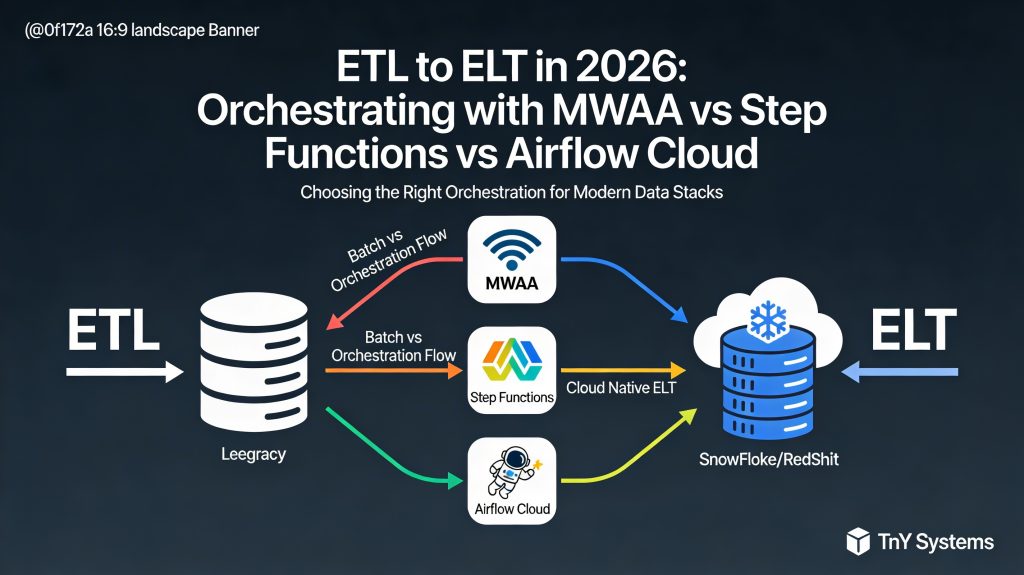
The world of data engineering in 2026 is changing fast. As organizations modernize their analytics stacks, ETL vs ELT is no longer just a technical preference—it’s a competitive strategy.
ELT (Extract, Load, Transform) pipelines have replaced legacy ETL workflows as cloud warehouses become faster, cheaper, and more flexible. But powering those workflows requires robust orchestration systems.
Three platforms dominate the landscape:
- 🌀 Amazon MWAA (Managed Workflows for Apache Airflow)
- ⚙️ AWS Step Functions
- ☁️ Airflow Cloud
Let’s unpack how these tools stack up on reliability, cost, and governance.
🔄 The Shift from ETL to ELT
Historically, ETL pipelines transformed data outside the warehouse first—often running on rigid, monolithic systems. In contrast, ELT sends raw data directly into modern warehouses like Snowflake, BigQuery, or Redshift, where transformations execute natively.
Why this shift?
✅ Elastic compute and storage scalability
✅ Simplified governance through centralized data
✅ Lower cost per transformation step
ELT pipelines also improve data pipeline reliability, reducing dependencies and failure points. They let teams focus on visibility and compliance since every transformation is traceable inside the warehouse.
🧩 MWAA, Step Functions, and Airflow Cloud Overview
Choosing the right orchestrator determines how efficiently your ELT strategy scales. Here’s what sets each apart ⬇️
🌀 Amazon MWAA
Managed Airflow on AWS that eliminates infrastructure overhead. Ideal for teams already using AWS Glue, S3, or Redshift. MWAA orchestration patterns offer superior flexibility and observability for DAG-based control.
⚙️ AWS Step Functions
Perfect for event-driven or serverless pipelines. Step Functions use a state machine model rather than DAGs, making them great for microservices orchestration or real-time data triggers.
☁️ Airflow Cloud
Fully managed Airflow from third-party providers. Great for hybrid or multi-cloud teams who want Airflow’s flexibility without maintaining their own clusters.
🧠 Quick insight:
When comparing Airflow vs Step Functions, it often comes down to control (Airflow) versus simplicity and scalability (Step Functions).
🧮 Reliability, Cost, and Governance
Let’s compare these orchestration tools on three critical dimensions:
🔧 Reliability
- MWAA and Cloud Airflow offer mature retry logic, visual DAG monitoring, and SLA management.
- Step Functions deliver event-level fault tolerance with built-in retries—making serverless pipelines resilient without manual setup.
💰 Cost Efficiency
- Step Functions use pay-per-state pricing—excellent for lightweight, event-driven workloads.
- MWAA/Cloud Airflow scale with compute resources, offering more transparency for predictable batch processing costs.
🛡️ Governance
- Airflow ecosystems shine here. They store complete run histories, metadata, and detailed logs.
- Step Functions integrate with CloudTrail for auditing but may lack native lineage depth.
🔍 Bottom line:
Choose Step Functions for modular serverless data operations, MWAA for AWS‑native alignment, and Cloud Airflow for cross‑platform flexibility.
⚡ Implementation Trends for 2026
Modern orchestration is heading toward automation‑driven intelligence:
- 📊 Metadata‑aware pipelines that self‑optimize for cost
- 🧠 AI‑assisted failure prediction and task reruns
- 🌐 Unified observability dashboards across multi‑tool data stacks
Teams building or migrating ELT systems are focusing on tighter feedback loops between orchestration, cost monitoring, and governance—an essential trio for sustainable data operations.
🏁 Conclusion
The evolution from ETL to ELT represents more than a workflow upgrade—it’s a mindset shift toward scalable, reliable, and cost‑optimized data platforms.
In 2025, the orchestration debate is not “which tool is best,” but “which orchestration pattern fits your operational maturity.” MWAA brings native AWS control, Step Functions drive efficiency through automation, and Airflow Cloud keeps hybrid pipelines adaptable.
Organizations that master orchestration design will lead the next wave of data‑driven innovation — automating governance, optimizing spend, and scaling faster than ever.